


What Makes a Realistic Diploma: Key Features Explained

Finding a realistic diploma that looks authentic without crossing ethical lines can feel complicated, especially when every detail matters for a convincing stage prop or a personal keepsake. Misunderstandings often blur the line between legitimate replicas and fraudulent credentials, leading to confusion about their true role. This guide explains the difference between novelty diplomas and those used for fraud, helping you choose responsible, display-only replicas that meet your needs while keeping your use ethical and transparent.
Table of Contents
Key Takeaways
| Point | Details |
| Realistic Diplomas vs. Fraud | Realistic diplomas are designed for legitimate uses and should not be confused with fraudulent documents used to deceive. |
| Key Features for Realism | Authentic-looking diplomas include high-quality materials, accurate typography, and security features that mimic real credentials. |
| Legitimate Uses of Replicas | Replica diplomas can be used in theatrical productions, film props, or personal keepsakes as long as their novelty status is clear. |
| Provider Quality Matters | Choosing a reputable provider is crucial to avoid scams and ensure that the diploma accurately represents what was ordered. |
Defining Realistic Diplomas and Common Misconceptions
A realistic diploma is a custom-designed document that closely resembles an authentic educational credential in appearance, layout, and physical characteristics. These diplomas are created for legitimate purposes such as theatrical productions, film props, personal memorabilia, or reenactments where authenticity in presentation matters.
The critical distinction lies in intent and use. Fake credentials used for fraud differ fundamentally from novelty diplomas designed purely for display or entertainment purposes. Understanding this difference is essential for responsible use.
What Makes a Diploma Look Realistic
Realistic diplomas share specific visual and structural characteristics that set them apart from obviously fake or generic documents:
-
High-quality paper stock with texture and weight that matches institutional standards
-
Precise printing techniques including embossing, special inks, and color layering
-
Authentic typography and layout matching the actual institution’s design
-
Security features such as watermarks, holographic elements, or specialty foils
-
Accurate institutional details including official logos, seals, and institutional names
-
Proper signatures and dates formatted according to actual diploma standards
A realistic diploma physically resembles an authentic credential in every visible detail, but serves only legitimate, non-fraudulent purposes.
Common Misconceptions About Realistic Diplomas
Many people misunderstand what realistic diplomas actually are and how they differ from fraudulent documents.
Misconception 1: All custom diplomas are fake.
Realistic diplomas created for theatrical use, props, or personal keepsakes are novelty items. Fraudulent diplomas claimed as genuine credentials for employment or education are entirely different products with malicious intent.
Misconception 2: Realistic diplomas can be used to misrepresent credentials.
Using any diploma to falsely claim educational achievements for employment, professional licensing, or advancement is fraud. Realistic diplomas are intended only for purposes where the recipient and audience understand they are novelty items, not authentic credentials.
Misconception 3: Realism equals authenticity.
Visual similarity to authentic diplomas does not make a document authentic. A realistic diploma is explicitly a novelty product. An authentic diploma contains official institutional records, verification numbers, and institutional backing.
Misconception 4: No one can tell the difference.
While realistic diplomas look convincing, educational institutions maintain official records and verification systems. Employers and educational bodies can verify credentials directly with institutions, making fraud easily detectable.
Why Clarity Matters
Distinguishing between realistic novelty diplomas and fraudulent credentials protects everyone involved. Clarity about purpose, use case, and ethical boundaries ensures these products serve their intended legitimate functions without crossing into illegal territory.
Pro tip: Always be transparent about your intended use when ordering a realistic diploma—whether it’s for theatrical production, film work, historical reenactment, or personal memorabilia, clarity protects both you and the provider.
Types of Replacement Diplomas and Their Uses
Replacement diplomas come in several distinct categories, each designed for specific purposes and audiences. Understanding which type suits your needs ensures you get a document that matches your intended use perfectly.
The main distinction separates novelty diplomas created for entertainment and display from replacement diplomas made to match lost or damaged originals. When ordering custom replacement diplomas, clarity about your category helps ensure the right product arrives.
High School Diplomas
High school diplomas are the most commonly ordered replacement documents. These serve multiple legitimate purposes across different scenarios:
-
Lost or damaged originals where the institution no longer has records or copies available
-
Theatrical productions requiring period-accurate or school-specific credentials for actors
-
Film and television productions needing authentic-looking background props
-
Personal memorabilia celebrating educational milestones for display purposes
-
Historical reenactments where accuracy in costume and documentation matters
High school diplomas typically feature the school’s official seal, graduation year, student name, and signature lines from administrators.
College and University Diplomas
University-level diplomas carry more weight visually and include additional security features. These documents are ordered for similar purposes as high school diplomas but often demand higher-quality production standards.
College diplomas typically include degree type, major or concentration, Latin honors (if applicable), and institutional branding specific to the university.
Replacement diplomas for theatrical use must match institutional styles from specific time periods, while personal memorabilia versions can reflect current designs.
GED Certificates
GED certificates serve graduates who completed high school equivalency testing rather than traditional graduation. These documents have distinct designs separate from standard diplomas and include official testing organization logos and certification numbers.
International and Specialty Diplomas
Vocational diplomas, technical certificates, and international educational credentials require specialized reproduction. These documents serve theatrical productions set in different countries or depicting specific technical training programs.
Different nations use unique formatting, languages, official seals, and security features. Accurate replication requires knowledge of each country’s specific diploma standards.
Diploma Covers and Presentation Packages
Many customers order decorative diploma covers alongside their replacement documents. These leather or faux-leather covers add authenticity to the overall presentation and protect the diploma from damage.
Covers can be customized with names, school logos, or graduation years, enhancing the keepsake quality of the final product.
Here’s a quick comparison of intended uses for different diploma types:
| Diploma Type | Most Common Legitimate Use | Typical Features | Important Consideration |
| High School Diploma | Lost original or personal display | School seal, signatures, year | Specify graduation year for accuracy |
| College/University Diploma | Theatrical/film props or display | Degree title, major, Latin honors | Match era design for authenticity |
| GED Certificate | Replacing official lost document | Testing org logo, certificate # | Ensure distinct format vs diplomas |
| International Specialty | Historical reenactment or props | Unique format, language, seals | Research country-specific standards |
Pro tip: Specify your exact intended use—theatrical, film, personal display, or replacement—when ordering, as this determines paper quality, security feature complexity, and production timeline needed for your project.
Essential Design Elements of Authentic Diplomas
Authentic diplomas share consistent visual and structural elements that institutions use to create official credentials. Understanding these components helps you recognize what makes a realistic diploma convincing and why each detail matters for display purposes.
Every legitimate institution includes core design features that distinguish their diplomas from generic documents. Customizing fonts, signatures, and seals requires knowledge of what institutional standards actually look like across different schools and countries.
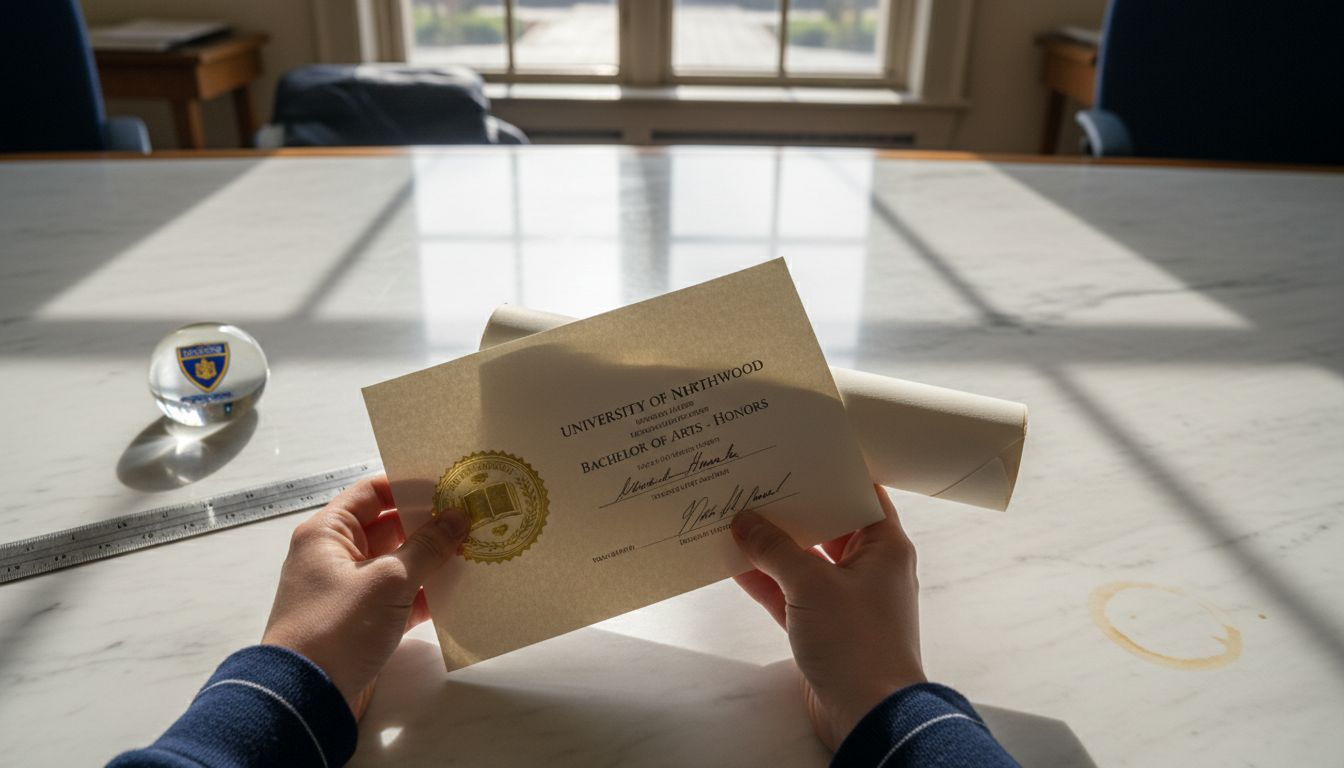
Core Visual Components
Authentic diplomas consistently include specific structural elements that serve both aesthetic and verification purposes:
-
Official institutional seal or logo prominently displayed, typically in the upper corner or center
-
Decorative borders or frames using patterns specific to the institution’s branding
-
School or university name in large, formal typography
-
Diploma title (“Diploma of Graduation,” “Bachelor of Science,” etc.)
-
Student name in calligraphy or formal script
-
Graduation date and degree conferred information
-
Signature lines for authorized institutional officials
-
Latin phrases or institutional mottoes reflecting the school’s values
Typography and Text Formatting
Font choice communicates formality and institutional prestige. Most diplomas use serif fonts for body text, creating a traditional, authoritative appearance that distinguishes them from casual documents.
Header text often appears in script or decorative fonts, while smaller text remains legible in standard fonts for legal readability.
Authentic diplomas balance visual elegance with functional clarity, using typography that signals importance without sacrificing readability.
Paper Stock and Texture
High-quality paper distinguishes authentic credentials from ordinary documents. Genuine diplomas typically use heavyweight parchment or cotton-blend paper with texture that feels substantial when held.
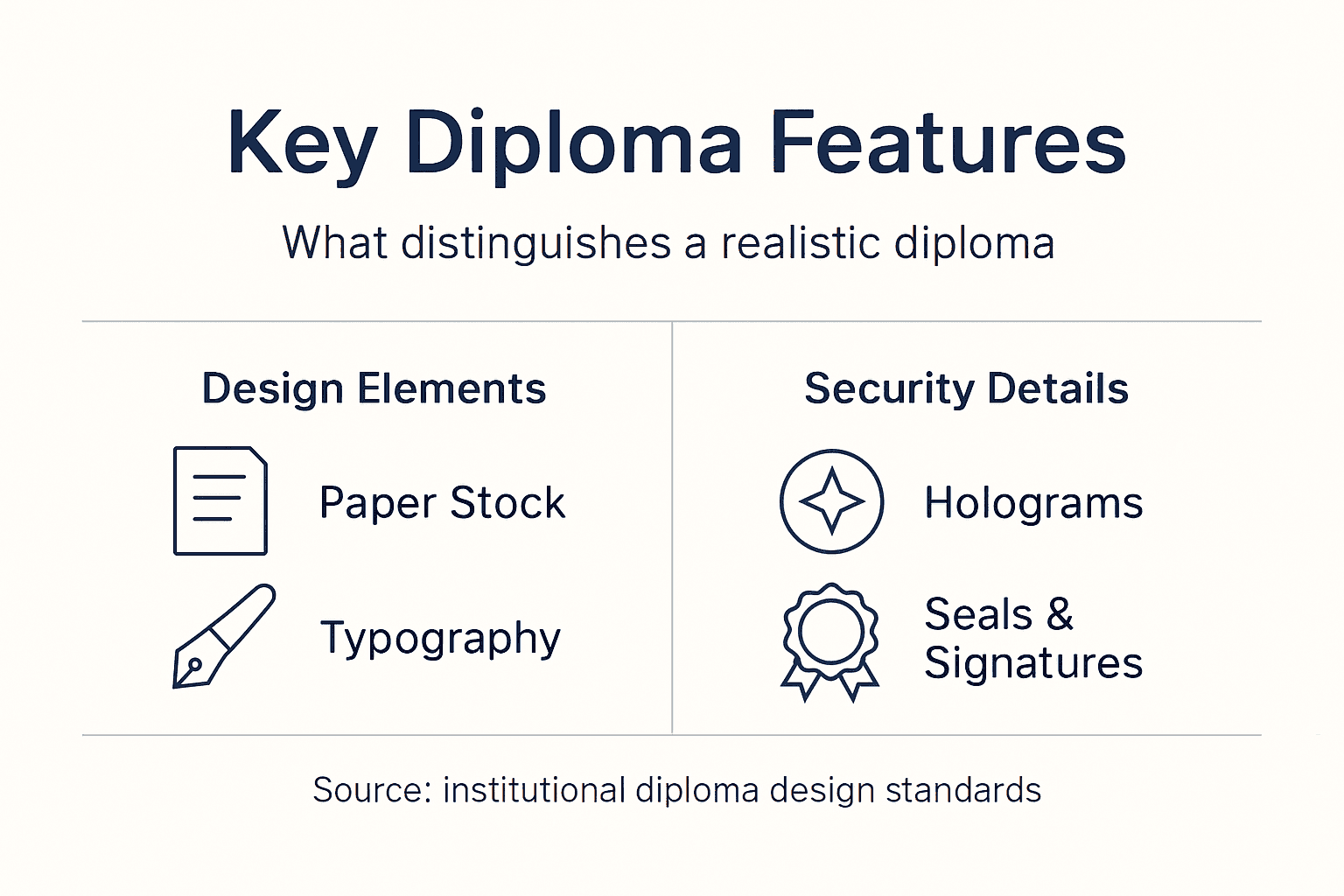
The paper’s cream or off-white color reflects traditional diploma standards, not bright white office paper.
Security and Anti-Fraud Features
Institutions incorporate subtle security measures to prevent counterfeiting:
-
Watermarks visible when held to light
-
Security threads embedded in the paper
-
Special inks that change color under certain light
-
Holographic foils or overlays on logos or seals
-
Microprinting in decorative borders
-
Unique serial or reference numbers
These features vary significantly by institution and country.
Institutional-Specific Details
Each school includes customized elements reflecting their identity. University colors appear in ribbon designs, decorative elements, or border accents that would be instantly recognizable to graduates.
Degree-specific language and terminology vary by program type, institution, and level.
Pro tip: When ordering a replacement diploma for theatrical use, specify the exact institution, graduation year, and degree program, as these details dramatically affect whether design elements match authentic versions from that specific time period.
Legal and Ethical Guidelines for Replica Use
Replica diplomas occupy a gray area legally and ethically. The difference between legitimate use and illegal fraud hinges entirely on your intent, transparency, and how you present the document to others.
Understanding these boundaries protects you legally and ensures your use of realistic diplomas remains ethical. Legitimate uses and ethical considerations clarify when replica diplomas cross from acceptable to illegal territory.
Legal Status of Replica Diplomas
Replica diplomas themselves are not inherently illegal to own or purchase. The legality depends entirely on how you use them.
Legal uses include:
-
Theatrical and film productions where documents are props
-
Historical reenactments requiring period-accurate materials
-
Personal memorabilia replacing genuinely lost originals
-
Educational demonstrations about diploma design
-
Museum or historical exhibits
Illegal uses include:
-
Presenting a replica as a genuine credential to employers
-
Using a replica to claim educational qualifications you don’t possess
-
Applying for professional licenses or certifications fraudulently
-
Deceiving educational institutions about your credentials
-
Altering a replica to forge signatures or institutional details
Using a replica diploma to deceive anyone about your actual qualifications is fraud, regardless of how realistic the document appears.
Fraud and Criminal Liability
Fraudulently using a diploma—real or replica—to obtain employment, professional certification, or educational advancement constitutes fraud. This offense can result in criminal charges, civil liability, and permanent damage to your reputation and career.
Employers who discover fraudulent credentials typically terminate employment immediately and may pursue legal action.
Ethical Standards for Legitimate Use
When using replica diplomas legitimately, ethical responsibility requires transparency and honesty about the document’s non-official status.
Ethical guidelines require:
-
Never misrepresenting the diploma’s authenticity to any audience
-
Clearly disclosing that the document is a replica if anyone questions its origin
-
Not altering the replica or forging signatures
-
Using the document only for the stated legitimate purpose
-
Keeping the diploma in your personal possession, not submitting it to institutions
-
Understanding that no institution will accept a replica as proof of credentials
Verification and Institutional Records
Educational institutions maintain official records completely separate from physical diplomas. Employers and licensing boards verify credentials directly with institutions, not by examining physical documents.
This means no realistic replica can fool verification systems.
Reputable Provider Standards
Legitimate diploma providers include clear disclaimers with every order. These statements emphasize that replicas are novelty items only and should never be used fraudulently.
Providers who don’t include such disclaimers may be facilitating illegal use.
Pro tip: When ordering a replica diploma, request written confirmation of its intended use and keep documentation showing you purchased it as a novelty item—this protects you legally if questions ever arise about the document’s origin.
Risks, Mistakes, and Choosing Quality Providers
Not all diploma providers are created equal. Low-quality replicas fail to convince anyone, waste your money, and waste your time. Choosing the right provider requires understanding what separates quality from garbage and recognizing common pitfalls.
The stakes matter more than you might think. A poorly made replica looks obviously fake, defeating the entire purpose of theatrical authenticity or personal display. Quality providers use advanced printing techniques and proper materials that distinguish legitimate operators from fly-by-night vendors.
Common Mistakes When Ordering
People make predictable errors when purchasing replica diplomas, often resulting in products that don’t meet expectations.
Frequent mistakes include:
-
Ordering from providers with minimal online presence or no verifiable history
-
Choosing based solely on price without examining quality indicators
-
Failing to verify that the provider actually delivers what they promise
-
Not requesting sample images before placing the full order
-
Skipping detailed communication about specific institutional details
-
Ignoring red flags like guaranteed “indistinguishable from authentic” claims
-
Paying upfront without any escrow or protection mechanisms
These mistakes often result in diplomas that look nothing like the originals you specified.
The table below summarizes how quality and risk differ among diploma providers:
| Provider Aspect | Quality Provider | Low-Quality/Scam Provider | Impact on Customer |
| Communication | Responsive and transparent | Evasive or vague | Smooth process vs. confusion |
| Material Authenticity | Matches official standards | Standard/copy paper | Convincing result vs. obvious fake |
| Customer Reviews | Detailed and specific | Generic or none | Builds trust vs. skepticism |
| Payment Security | Escrow or proof required | Upfront with no protection | Reduced risk vs. more scams |
Quality diploma providers are transparent about timelines, materials, and realistic limitations—not promising miracles.
Evaluating Provider Quality
Quality indicators reveal whether a provider takes their work seriously. Legitimate operators invest in materials, printing equipment, and accuracy that cheaper competitors skip.
Indicators of quality include:
-
High-quality paper stock matching institutional standards, not standard printer paper
-
Professional printing techniques including embossing, watermarks, and proper color reproduction
-
Accurate font matching specific to the institution and graduation year
-
Proper seal reproduction with authentic appearance and dimension
-
Detailed customer feedback describing specific experiences and quality assessments
-
Clear communication before ordering about capabilities and timeline
-
Sample availability allowing you to verify quality before committing
-
Ethical disclaimers explicitly stating proper use only
Reviewing Customer Feedback
Real customer reviews provide the clearest picture of provider reliability. Look for detailed feedback describing specific strengths and weaknesses rather than generic praise.
Trustworthy reviews include: specific details about paper quality, printing accuracy, turnaround time, and customer service. Generic five-star reviews without substance suggest fake feedback.
Avoid providers with suspiciously perfect ratings or virtually no reviews at all.
Red Flags and Scams
Certain warning signs indicate a provider isn’t legitimate or won’t deliver quality work. Providers making unrealistic claims or using aggressive sales tactics prioritize speed and volume over craftsmanship.
Warning signs include guarantees of perfect indistinguishability, pressure to pay without samples, no clear contact information, vague descriptions of materials, and refusal to answer specific questions about quality or institutional details.
Pro tip: Request a physical sample of the exact diploma you’re considering ordering before paying the full amount—legitimate providers understand this protects both parties and demonstrates confidence in their work quality.
Discover Authentic Custom Diplomas Designed to Impress
Struggling to find realistic diplomas that truly capture the quality and detailed features you learned about in this article? At Hey Congrats, we specialize in creating custom replacement and novelty diplomas that meet your exact needs. Whether you require diplomas for personal display, theatrical productions, or memorabilia, our products carefully replicate the essential design elements like institutional seals, proper typography, and high-quality paper stock. We understand how important authenticity and responsible use are when ordering realistic diplomas.
Explore our wide selection of Diploma Maker | Custom Replacement & Novelty Diplomas – Hey Congrats! and pair your order with elegant Buy diploma cover and transcripts: Hey Congrats – Hey Congrats!. Take control today and order a product that honors your educational achievements or elevates your next project with unmatched realism. Visit Hey Congrats now to browse options, request samples, and experience exceptional quality backed by expert customer support.
Frequently Asked Questions
What are the key features of a realistic diploma?
Realistic diplomas feature high-quality paper stock, precise printing techniques, authentic typography, security features like watermarks or holograms, and accurate institutional details such as logos and seals.
How do realistic diplomas differ from fake credentials used for fraud?
Realistic diplomas are designed for legitimate purposes, such as props in theatrical productions or personal memorabilia, whereas fake credentials are used to deceive others about one’s qualifications.
Can realistic diplomas be used to misrepresent educational achievements?
No, using any diploma to falsely claim educational qualifications is considered fraud. Realistic diplomas should only be used where it is understood that they are novelty items.
What common misconceptions exist about realistic diplomas?
Common misconceptions include believing that all custom diplomas are fake or that realism equals authenticity. It’s essential to understand that a realistic diploma is a novelty item and not a legitimate credential.


