


How Diploma Replicas Work: 100% Visual Authenticity

Many people confuse replica diplomas with fake diplomas designed for fraud, but the reality is entirely different. Replica diplomas are legitimate, high-quality reproductions created for personal display, theatrical use, or memorabilia without any security features that authenticate real credentials. This guide explains how replicas achieve visual authenticity through production methods, customization options, legal boundaries, and responsible use practices.
Table of Contents
Key Takeaways
| Point | Details | |-------|---------|| | Replica diplomas are legal reproductions | They exclude security features like UV watermarks found in authentic diplomas. | | Customization includes school details | Names, dates, and degrees are personalized, but verification features are omitted. | | Legal for display and props only | Never valid for employment verification or academic admissions. | | Premium materials ensure authenticity | High-quality paper, embossing, and foil stamping replicate original appearance. | | Reputable providers guarantee ethics | Transparent policies and customer service protect buyers from misuse. |
Introduction to Diploma Replicas and Their Purpose
Replica diplomas are legal reproductions crafted for personal or theatrical use, distinctly different from fraudulent documents intended to deceive. Replica diplomas exclude security features like UV watermarks and microprinting embedded in authentic credentials. Unlike fake diplomas designed for fraud, replicas serve legitimate purposes without criminal intent.
People acquire replicas for several valid reasons:
-
Displaying achievements when original diplomas are lost, damaged, or stored safely
-
Creating theatrical props for film, stage productions, or historical reenactments
-
Preserving memorabilia from educational milestones without risking original documents
-
Celebrating accomplishments in home or office settings
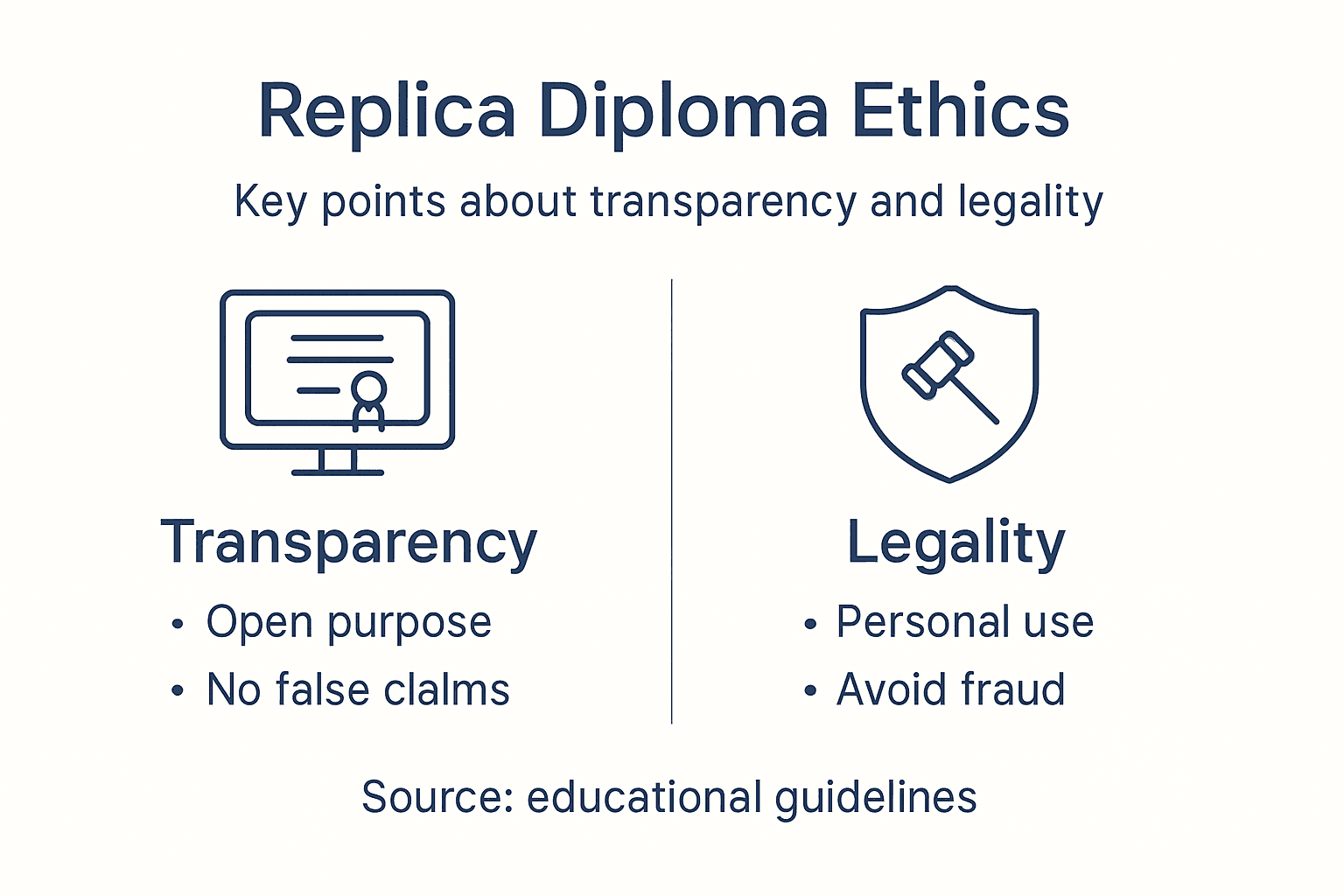
The ethical distinction lies in transparency and purpose. Replicas never claim official validation or attempt to misrepresent credentials. They are commemorative items recognizing personal achievement without legal or academic authority. Understanding this difference protects consumers from confusion and ensures responsible ownership.
Common concerns about replicas often stem from media reports conflating legitimate reproductions with fraudulent schemes. Reputable providers clearly label products as novelty items, include ethical use guidelines, and refuse orders intended for deception. This framework maintains the legal status of replica diplomas while preventing misuse.
How Replica Diplomas Are Made: Production and Materials
Producing visually authentic replicas demands precision craftsmanship combining premium materials with advanced printing technology. Advanced printing methods for diploma replicas use heavyweight cardstock or parchment paper matching the weight and texture of originals.
Manufacturers employ digital design tools for diploma replicas like Adobe Illustrator and Photoshop to recreate fonts, logos, seals, and signatures with exact precision. High-resolution scanning of authentic templates ensures every detail from border patterns to seal placement mirrors real diplomas.
Key production elements include:
-
Premium paper stock ranging from 80 to 120 pound weight for durability
-
Offset or digital printing delivering sharp text and vibrant colors
-
Embossing creating raised seals and institutional crests
-
Foil stamping adding gold or silver metallic accents
Embossing and foil stamping provide tactile authenticity that distinguishes quality replicas from basic printouts. The raised textures and metallic elements replicate the physical characteristics original diplomas possess. However, replicas intentionally omit security features like holographic overlays, UV reactive ink, and microprinting that authenticate real credentials.
| Feature | Real Diploma | Replica Diploma |
| Paper Quality | Security paper with watermarks | Premium cardstock or parchment |
| Printing Method | Specialized secure printing | High-resolution digital or offset |
| Security Features | UV watermarks, holograms, microprinting | None included |
| Embossing | Official institutional seal | Decorative embossed seal |
| Legal Status | Valid credential | Novelty item only |
Pro Tip: Before ordering, request sample images showing paper texture and embossing depth. Quality providers offer detailed photos or physical samples demonstrating craftsmanship standards.
Customization and Personalization Options
Personalization transforms generic templates into meaningful keepsakes reflecting individual achievements. Reputable providers offer extensive customization options for replica diplomas while maintaining ethical boundaries.
Standard customization features include:
-
School or university name matching your institution
-
Degree type and field of study reflecting your program
-
Graduation date corresponding to your completion year
-
Personalized recipient name in calligraphic script
-
Optional Latin honors designations
Matching transcripts can accompany diplomas with personalized course listings, grades, and GPA details for complete document sets. These complementary items enhance display value while remaining clearly marked as novelty products.
Proofing services let buyers review digital mockups before final production. This quality control step ensures correct spelling, proper seal placement, and accurate formatting matching expectations. Adjustments can be requested until every detail meets satisfaction standards.
Customization limits exist to prevent misuse. Providers exclude elements that could authenticate documents fraudulently, such as registrar signatures with contact information, official verification codes, or security features mimicking real credentials. These boundaries protect both sellers and buyers from legal complications.
Pro Tip: Always request digital proofs showing exact detail placement and spelling. Verify institution name spelling, date formats, and degree wording match your preferences before approving final production.
Legal and Ethical Guidelines for Replica Diplomas
Understanding legal and ethical guidelines for replica diplomas protects owners from unintended consequences. Replica diplomas occupy a clear legal space when used appropriately but cross into criminal territory when misused.
Legal ownership parameters:
-
Owning replica diplomas for personal display is entirely legal
-
Using replicas as theatrical props or film set decorations is permitted
-
Keeping replicas as commemorative memorabilia violates no laws
-
Selling replicas clearly labeled as novelty items remains lawful
Illegal uses carry serious consequences:
-
Presenting replicas to employers during hiring processes constitutes fraud
-
Submitting replicas for academic admissions violates education laws
-
Using replicas to obtain professional licenses triggers criminal charges
-
Any deceptive use misrepresenting credentials invites prosecution
Using replica diplomas for employment verification or academic admission is illegal and punishable by fines, criminal charges, and permanent damage to professional reputation. Employers routinely verify credentials through institutional registrars, making fraud detection inevitable.
Employers actively combat credential fraud through verification services contacting issuing institutions directly. National Student Clearinghouse and similar databases allow instant authentication checks exposing fraudulent submissions immediately. The risk of detection approaches certainty rather than possibility.
Ethical ownership requires transparency. Keep replicas separate from authentic documents, never present them as official credentials, and use them exclusively for intended commemorative or theatrical purposes. Responsible providers reinforce these guidelines through clear labeling and customer education.
Common Misconceptions About Replica Diplomas
Clearing up common misconceptions about replica diplomas helps potential buyers make informed decisions. Several widespread myths distort understanding of what replicas are and how they function.
-
Replica diplomas are fake diplomas used for fraud. Replicas are legal commemorative items never intended to deceive. Fakes target fraudulent use, while replicas serve display and theatrical purposes transparently.
-
Replica diplomas contain real diploma security features. Quality replicas intentionally omit UV watermarks, holograms, and microprinting that authenticate real credentials, making them clearly distinguishable under examination.
-
Using replicas for job applications is legal if disclosed. Any submission of replicas to employers or institutions is illegal regardless of disclosure. Only authentic credentials verified through official channels satisfy legal requirements.
-
Replica diplomas can pass verification checks. Employers verify credentials directly with issuing institutions. Replicas lack database records and registrar validation, making detection immediate and certain.
-
All replica providers operate unethically. Reputable providers clearly label products as novelty items, include ethical use policies, and educate customers about legal boundaries, operating entirely within legal frameworks.
High-quality replicas serve valuable purposes when used appropriately. They preserve memories of educational achievements, replace lost originals for display, and provide realistic props for creative projects. The key distinction lies in transparency and purpose rather than appearance quality.
Choosing a Reputable Replica Diploma Provider
Selecting trustworthy providers ensures quality products and ethical use policies of replica diploma providers protecting buyers. Several criteria distinguish reputable suppliers from questionable operations.
Evaluation factors include:
-
Material and print quality demonstrated through sample images or physical samples
-
Transparent customization processes with proofing options before final production
-
Clear ethical use policies stating legal boundaries and intended purposes
-
Responsive customer service addressing questions and concerns promptly
-
Positive customer reviews confirming product quality and reliable delivery
Reputable providers openly discuss their products as novelty items without making false claims about authenticity or verification. They educate customers about legal use limits and refuse orders intended for fraudulent purposes. This transparency protects both parties from legal complications.
Choosing a reputable replica diploma provider requires research. Compare material specifications, review customization options, and verify satisfaction guarantees. Providers offering samples demonstrate confidence in product quality worth investigating further.
Warning signs of questionable providers include promises of credentials passing verification checks, claims about including security features, or vague terms avoiding clear ethical boundaries. These red flags indicate operations potentially facilitating fraud rather than serving legitimate commemorative purposes.
Pro Tip: Read customer reviews focusing on delivery times, product accuracy, and customer service responsiveness. Request sample diplomas or detailed images before placing orders to confirm quality standards meet expectations.
Using Replica Diplomas Responsibly: Practical Applications
Responsible uses of replica diplomas enhance personal spaces and creative projects without crossing ethical boundaries. Understanding appropriate applications ensures lawful ownership benefiting from replica advantages.
Legitimate use cases:
-
Home or office display celebrating educational achievements without risking original documents
-
Theatrical productions requiring realistic props for period accuracy or contemporary scenes
-
Film and television sets needing authentic-looking credentials for character development
-
Historical reenactments demanding era-appropriate educational documents
-
Personal backup copies commemorating lost originals as memorabilia
Display purposes represent the most common legitimate application. Original diplomas face damage risks from sunlight, humidity, and handling when prominently displayed. Replicas allow proud exhibition while originals remain safely stored. This practical solution protects valuable credentials while maintaining visible recognition of achievements.

Theatrical and film applications benefit from replica authenticity without budget constraints or security concerns associated with handling genuine documents. Productions can customize replicas matching specific character backgrounds or historical periods impossible with authentic credentials.
Boundaries remain crucial. Never present replicas to employers, educational institutions, licensing boards, or any entity requiring credential verification. Keep replicas physically separate from authentic documents preventing accidental confusion. Label replica storage clearly distinguishing commemorative items from official records.
Comparison Table: Replica Diplomas vs Real Diplomas
Understanding concrete differences between replicas and authentic diplomas clarifies appropriate use cases and legal distinctions.
| Aspect | Replica Diploma | Real Diploma |
| Purpose | Display, props, memorabilia | Official credential verification |
| Production | Digital printing, embossing, premium paper | Secure printing with embedded security |
| Security Features | None included | UV watermarks, holograms, microprinting |
| Legal Status | Novelty item only | Valid credential with legal authority |
| Verification | Cannot be verified | Verifiable through institutional registrars |
| Cost | $50 to $200 typically | Original issuance through tuition |
| Customization | Extensive personalization options | Fixed details matching academic records |
| Common Uses | Home display, film props | Employment, admissions, licensing |
This comparison illustrates why replicas serve specific purposes while real diplomas fulfill entirely different functions. The absence of security features and verification capabilities defines replicas as commemorative items rather than functional credentials.
Explore High-Quality Replica Diplomas at Hey Congrats!
Hey Congrats! offers custom replacement diplomas crafted with premium materials and precise customization matching your educational achievements. Each replica undergoes careful production ensuring visual authenticity suitable for display and creative projects.
Our customization process includes digital proofing, allowing you to review exact details before final production. Choose from extensive diploma covers and transcripts completing your commemorative document set. The custom transcript maker lets you personalize course listings and grades matching your academic history.
Transparent ethical use policies guide responsible ownership, clearly defining legal boundaries and intended purposes. Our customer service team answers questions about materials, customization options, and appropriate use cases. Request samples to evaluate quality standards before ordering your personalized replica.
FAQ
What are replica diplomas?
Replica diplomas are high-quality reproductions of original educational credentials designed for display, theatrical props, or commemorative purposes. They replicate visual appearance through premium materials and precise printing but exclude official security features like watermarks and holograms. Replicas serve as novelty items without legal validity for employment or academic verification.
Can replica diplomas be used for job applications?
Using replica diplomas for employment verification or academic admission is illegal and constitutes fraud. Employers verify credentials directly through institutional registrars, making detection certain. Criminal penalties, fines, and permanent professional reputation damage result from fraudulent credential submission.
How do I ensure my replica diploma looks authentic?
Tips for authentic-looking replica diplomas include requesting samples or detailed images before ordering. Choose providers offering premium paper stock, embossing, and foil stamping. Verify customization accuracy through digital proofing services ensuring correct spelling and proper detail placement.
Are replica diplomas legal to own?
Owning replica diplomas for personal display, theatrical use, or memorabilia is completely legal. The legality depends entirely on use rather than ownership. Misusing replicas for employment fraud, academic admissions, or professional licensing carries criminal penalties and legal consequences.
How long does it take to receive a custom replica diploma?
Most reputable providers deliver custom replica diplomas within 7 to 14 business days after proof approval. Rush options may reduce delivery time to 3 to 5 days for urgent needs. Production time varies based on customization complexity and provider workload.
What makes replica diplomas different from fake diplomas?
Replica diplomas are legal novelty items clearly marketed for display and props, while fake diplomas target fraudulent use deceiving employers or institutions. Replicas intentionally exclude security features and lack verification capabilities. Ethical providers educate customers about legal boundaries and refuse orders intended for deception.


