


Fake GED Diplomas: Risks, Legality, and Safe Uses

Every theater director or collector has faced the challenge of sourcing a realistic diploma for a special project or cherished keepsake. Creating a convincing document for a film set or as a personal milestone prop can add authenticity and personal meaning, but the difference between a novelty and an illegal credential is vital. This guide shows what makes a diploma truly legitimate for entertainment and commemorative use, while protecting you from costly mistakes.
Table of Contents
- What Is a Fake GED Diploma?
- Common Types of Fake GED Diplomas
- Legal Status and Verification Methods
- Responsible Uses for Fake GEDs
- Risks, Penalties, and Safer Alternatives
Key Takeaways
| Point | Details |
|---|---|
| Fake GED diplomas lack legitimacy | These documents imitate real diplomas but are created without accredited backing and have no academic validity. |
| Consequences of using fake diplomas are severe | Misrepresentation of credentials can lead to criminal charges, loss of employment, and permanent damage to one’s professional reputation. |
| Clear distinctions exist between diploma types | Understanding the differences between novelty, replica, and fraudulent diplomas can mitigate legal risks. |
| Legitimate GED options are available | The process of earning a real GED is accessible, cost-effective, and provides tangible employment opportunities without legal repercussions. |
What Is a Fake GED Diploma?
A fake GED diploma is a document that mimics the appearance of a legitimate General Educational Development credential but lacks any academic validity or official recognition. Unlike earned diplomas, these are created without completing the required coursework or passing the official GED exam.
Fake diplomas typically come from unaccredited providers or diploma mills. They might look visually identical to real credentials, complete with official-looking seals, signatures, and security features. The key difference is what’s underneath: nothing of substance.
How Fake Diplomas Work
These documents are designed to deceive. Here’s what typically happens:
- A provider offers to create a diploma for a fee
- You supply personal details (name, graduation date, school name)
- The provider prints a customized document
- You receive something that looks authentic but has no institutional backing
The problem is verification. When employers or institutions check credentials, they contact the school directly. A fake diploma fails instantly because no record of your graduation exists in any official database.
Why People Seek Them Out
Individuals pursue diploma solutions for various reasons—some want replacements for lost originals, others seek props for theatrical productions, and some falsely attempt to meet employment or educational requirements.
The distinction matters legally and ethically. Using a fake diploma to misrepresent your qualifications for a job, college admission, or professional license is fraud. Creating props for film, theater, or personal memorabilia sits in a different legal category.
Critical Legal Reality
Fake credentials used deceptively carry serious consequences. You risk criminal charges, employment termination, and civil lawsuits.
Employers conduct background checks. Educational institutions verify transcripts. Medical boards demand proof of credentials. The moment your false diploma encounters verification protocols, it’s exposed.
Real credentials are verified through official channels. Fake diplomas collapse under any legitimate verification process.
What Separates Legitimate from Illegitimate
Legitimate replacement diplomas come directly from accredited institutions or verified diploma services. They’re based on actual graduation records. Illegitimate versions are created purely for deception without any institutional relationship.
The quality of the physical document doesn’t determine legitimacy. A beautifully printed fake is still fake. What matters is institutional verification and official records.
Here’s how legitimate and illegitimate GED diplomas differ:
| Aspect | Legitimate Diploma | Fake Diploma |
|---|---|---|
| Source | Accredited school or testing center | Unaccredited provider or mill |
| Verification | Tracked in official databases | No records exist |
| Legal Risk | None if earned | High, can lead to prosecution |
| Acceptance | Recognized by employers and schools | Rejected during background checks |
| Purpose | Document actual achievement | Intended to mislead or deceive |
Pro tip: If you need a replacement diploma for a legitimate reason, request it directly from your school’s registrar office rather than through third-party providers—this ensures complete authenticity and eliminates legal risk.
Common Types of Fake GED Diplomas
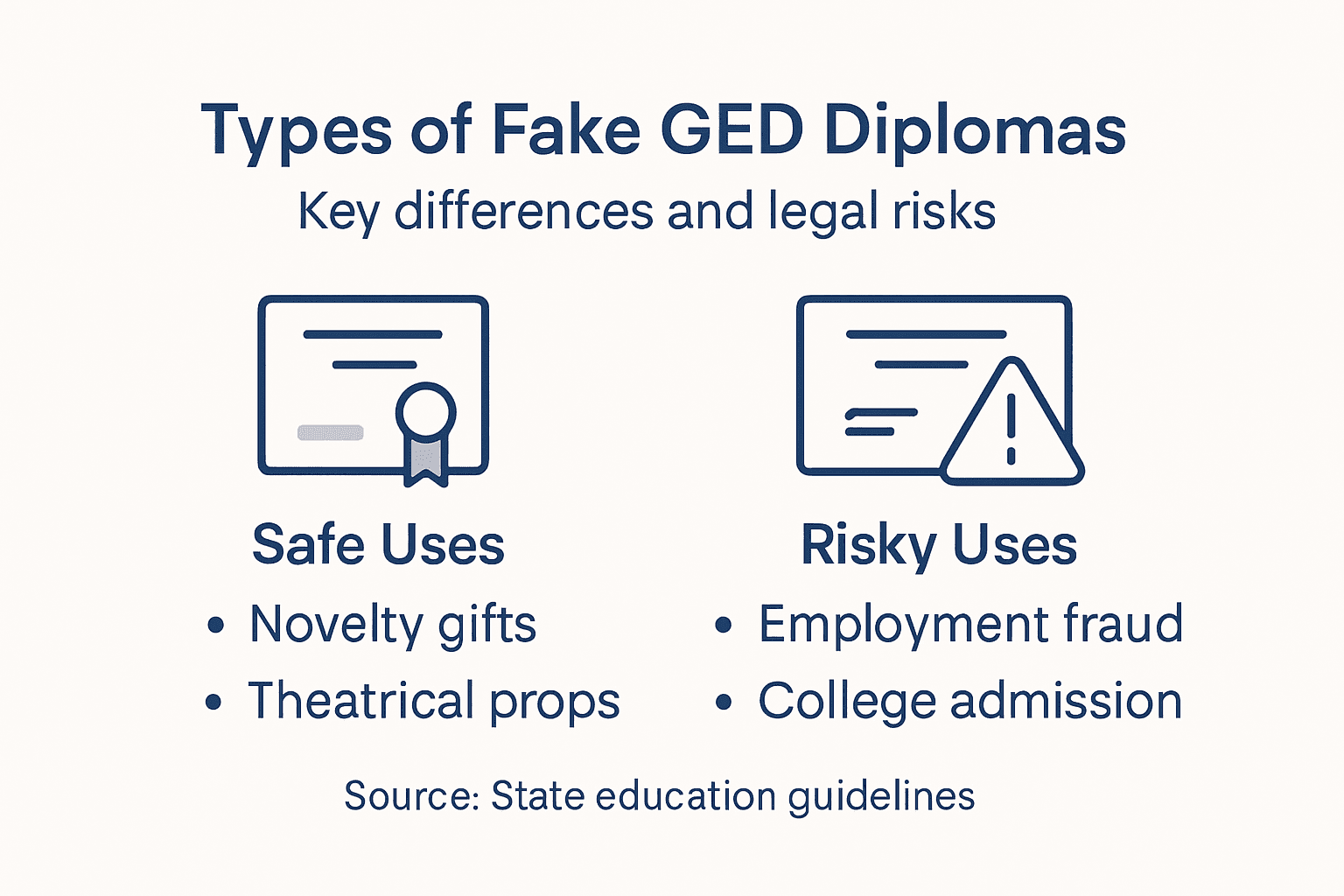
Fake GED diplomas come in several distinct categories, each with different purposes and legal implications. Understanding these types helps you recognize the risks and determine what you’re actually dealing with.
Three Main Categories
Fake diplomas generally fall into three groups:
- Novelty diplomas created for jokes, pranks, or entertainment purposes
- Replica diplomas designed to look like real credentials but not intended as deceptive replacements
- Fraudulent diplomas from diploma mills claiming false accreditation and used to deceive employers or institutions
Each type carries different consequences depending on how it’s used.
Novelty Diplomas
Novelty versions are printed as jokes or props without any intent to deceive. Think gag gifts for retirement parties or props for theater productions. These are typically obvious fakes—oversized, humorous, or clearly marked as novelty items.
The legal risk is minimal if they’re never used to misrepresent qualifications. A novelty diploma sitting on your shelf causes no harm. Using one to apply for a job crosses into fraud territory instantly.
Replica Diplomas
Replica diplomas attempt to replicate the appearance of legitimate credentials but are sold explicitly as replacements or commemorative items. They’re physically similar to real diplomas but lack institutional backing.
These exist in a gray zone. Some are legitimate replacement services for lost originals. Others are sold as decorative items knowing buyers might misuse them. The distinction between legal and illegal use depends entirely on your intent.
Diploma Mill Frauds
The most dangerous category comes from diploma mills offering false accreditation. These providers claim to represent accredited institutions or offer degrees without requiring coursework.
Diploma mills deliberately deceive. They knowingly sell fraudulent credentials designed to fool employers and educational institutions. This is criminal activity with serious federal penalties.
The purpose behind each type determines its legality—props for theater differ vastly from documents used to secure employment through deception.
Identifying the Type You’re Dealing With
Look for these markers:
- Explicit novelty labeling = likely legitimate entertainment use
- Missing institutional records = always fraudulent for professional use
- Claims of unaccredited credentials = diploma mill fraud
- Sold for theatrical or memorial purposes = potentially legal
- Sold to misrepresent qualifications = always illegal
The physical quality of the diploma matters less than the institutional verification behind it.
Pro tip: If you need a diploma for legitimate purposes like theatrical productions or personal memorabilia, request an explicit novelty designation from the provider to establish clear legal defensibility for your purchase.
Legal Status and Verification Methods
Fake GED diplomas occupy a clear legal position: they are fraudulent documents. Using one to misrepresent your qualifications is illegal in most jurisdictions and carries serious penalties.

The Legal Landscape
Fake diplomas are criminal. Many states have explicit laws against using counterfeit educational credentials. The federal government is actively considering legislation to criminalize fake GED certificates nationwide.
The consequences extend beyond criminal charges. You face:
- Employment termination when discovered
- Civil lawsuits from employers or institutions
- Permanent damage to professional reputation
- Potential imprisonment and fines
- Loss of professional licenses
The severity depends on jurisdiction and how the diploma was used.
How Institutions Verify Credentials
Verification is straightforward and foolproof. When an employer or school needs to confirm your GED:
- They contact your state’s education department directly
- They use official verification services from the GED Testing Service
- They check security features like seals and signatures
- They cross-reference institutional databases
No fake diploma survives this process. The moment verification begins, the fraud collapses.
Verification Methods You Should Know
Spotting fake credentials requires checking security features and institutional backing. Here’s what institutions actually check:
- Official seals and watermarks
- Signature authenticity from school officials
- Institutional database records
- GED Testing Service official records
- Holographic security elements
A quality fake might pass visual inspection but fails instantly when institutions contact the supposed issuing school.
State-by-State Enforcement
Legal consequences vary by location. Some states aggressively prosecute diploma fraud with felony charges. Others treat it as a misdemeanor but still enforce employment consequences.
What’s universal: discovery leads to prosecution. Background checks during hiring or licensing will expose the fraud.
Using a fake diploma is not a gray area—it is documented fraud with predictable legal consequences.
The Verification Trail
Once you use a fake diploma for employment or educational purposes, you create a paper trail. Background checks, verification requests, and institutional databases all flag discrepancies instantly.
Employers and educational institutions verify credentials as standard procedure. This isn’t optional—it’s mandatory for legal compliance and risk management.
Pro tip: Before pursuing any diploma solution, confirm directly with your state’s education department or the GED Testing Service whether you’re eligible for legitimate replacement options, as many states offer free or low-cost official diploma replacements for lost originals.
Responsible Uses for Fake GEDs
Not all uses of fake GED diplomas are illegal. There exists a legitimate space for novelty and commemorative documents when used transparently and ethically. The key difference lies in intent and disclosure.
The Clear Legal Line
Responsible use means never attempting to pass a fake diploma off as a real credential. You cannot use it to gain employment, secure college admission, obtain professional licensure, or claim qualifications you don’t actually possess.
Fake diplomas used responsibly should never misrepresent academic qualifications to employers or institutions. The moment deception enters the picture, responsible use ends and fraud begins.
Legitimate Uses That Are Legal
Several scenarios allow for ethical fake diploma use:
- Theatrical productions and film sets needing realistic props
- Gag gifts for retirement parties or milestone celebrations
- Personal memorabilia for novelty or entertainment purposes
- Educational demonstrations showing credential design elements
- Costume pieces for theatrical or costume parties
Each of these involves zero intent to deceive institutions or employers.
The Transparency Requirement
Clear disclosure is your legal protection. When using a fake diploma for legitimate purposes, everyone involved must know it’s not real.
If you’re creating props for a theatrical production, the production team knows these are props. If you’re giving a gag diploma at a retirement party, guests understand it’s a joke. This transparency makes all the difference legally.
What Responsible Use Looks Like
Responsible diploma use has specific characteristics:
- Never submitted to employers or schools
- Never used to claim qualifications you lack
- Clear labeling as novelty, prop, or commemorative item
- Shared only with people who understand its non-legitimate status
- Kept separate from official documents
A fake diploma gathering dust in your entertainment box poses zero legal risk. The same diploma on your resume is a felony.
This table highlights safe and risky uses for fake GED diplomas:
| Use Scenario | Legal Status | Key Consideration |
|---|---|---|
| Movie or theater prop | Legal if disclosed | Never submitted with applications |
| Employment application | Illegal, fraudulent | Triggers criminal liability |
| Personal memorabilia | Legal if transparent | Not mistaken for real credential |
| Educational demonstration | Legal if disclosed | Must not mislead observers |
| College admission | Illegal, fraudulent | Causes expulsion if discovered |
The Documentation Question
If you’re using a fake diploma responsibly, you shouldn’t need to hide it. There’s no reason to submit it anywhere official. It exists purely for entertainment or theatrical purposes.
The moment you feel compelled to hide something or submit it officially, you’ve crossed from responsible use into fraud.
Responsible use requires complete transparency about the document’s non-legitimate status with everyone involved.
How Hey Congrats Supports Responsible Use
When purchasing novelty or replacement diplomas for legitimate purposes, work with providers who explicitly market their products as novelty items. Clear labeling and transparent communication protect both buyer and seller.
Providers that emphasize theatrical, commemorative, and entertainment uses help customers stay on the legal side of diploma solutions.
Pro tip: Request explicit novelty certification or documentation from your provider confirming the diploma is marketed for non-fraudulent purposes—this creates a clear paper trail proving your intent was legitimate entertainment or prop use, not credential fraud.
Risks, Penalties, and Safer Alternatives
Using a fake GED diploma carries severe consequences that extend far beyond a single employment rejection. The risks are real, the penalties are substantial, and the damage is often permanent.
The Consequences Are Serious
Using fake GED diplomas leads to criminal charges and employment loss. You face potential imprisonment, significant fines, and permanent damage to your professional reputation.
Once you’re caught—and detection is virtually guaranteed—the fallout extends beyond legal penalties:
- Criminal record that follows you permanently
- Permanent ban from future employment in certain fields
- Loss of professional licenses or certifications
- Difficulty finding housing or securing loans
- Social and family embarrassment
- Loss of educational opportunities
The conviction becomes public record.
Detection Methods Are Advanced
Employers and institutions now use sophisticated verification systems. They don’t just check if you graduated—they verify specific details through multiple databases simultaneously.
One employer’s background check exposes everything. The fraud becomes part of your permanent employment history, visible to every future employer.
Legal Penalties You Face
Fake diploma use results in fines, fraud charges, and criminal prosecution. Penalties vary by jurisdiction but typically include:
- Felony charges in most states
- Prison sentences ranging from months to years
- Fines exceeding thousands of dollars
- Restitution payments to affected institutions
- Probation and supervised release
Federal charges carry even harsher penalties.
Why the Legitimate Path Is Better
Earning a real GED is genuinely achievable. The GED exam is designed for adult learners who didn’t finish traditional high school. Thousands of people pass it every year.
A legitimate GED:
- Takes weeks to months of study, not years
- Costs under $500 for testing and preparation
- Opens actual doors to employment and education
- Requires no deception or legal risk
- Provides lifetime professional credibility
- Can be completed while working full-time
Getting Your Real GED
The process is straightforward. Register with your state’s GED testing service, prepare using free or low-cost study materials, and sit for the exam.
Many community colleges offer free GED prep classes. Study apps cost less than $50. The exam itself runs approximately $150 total.
A legitimate GED eliminates all legal risk, provides actual employer recognition, and costs dramatically less than the consequences of fraud.
Comparing Your Options
Fake diploma: Criminal charges, employment termination, reputational destruction.
Real GED: Four legitimate pathways to employment and education without any legal risk.
The fake path destroys your future. The legitimate path builds it.
Pro tip: Start with your state’s GED testing service website to find free prep resources, testing locations, and payment plan options—most states offer fee waivers for low-income applicants, making the legitimate credential essentially free compared to the cost of criminal prosecution.
Discover Safe and Responsible GED Document Solutions with Hey Congrats!
Navigating the risks and legal challenges of fake GED diplomas can be overwhelming. Whether you need a high-quality replacement, a novelty diploma for theatrical use, or a commemorative piece, Hey Congrats! offers custom, authentic-looking GED certificates that respect legal boundaries while delivering exceptional quality. We understand the importance of transparency and responsible use to avoid the severe consequences associated with fraudulent diplomas.

Explore our selection at Buy a GED Certificate Online - Replacement & Novelty – Hey Congrats! to find customizable options tailored to your needs. Act now to secure a reliable and legally compliant alternative. Visit Hey Congrats! today for fast shipping, excellent customer service, and products designed with your peace of mind in mind.
Frequently Asked Questions
What are the risks of using a fake GED diploma?
Using a fake GED diploma can lead to serious legal consequences, including criminal charges, employment termination, and permanent damage to your professional reputation. If discovered, you might face fines, imprisonment, and a criminal record that can hinder future opportunities.
How can employers verify the authenticity of a GED diploma?
Employers typically verify GED diplomas by contacting the issuing state’s education department, checking official databases, and using verification services from the GED Testing Service. They look for institutional records, official seals, and signatures to confirm authenticity.
What are the different types of fake GED diplomas?
Fake GED diplomas can be categorized into three main types: novelty diplomas (used for jokes or props), replica diplomas (attempts to mimic real credentials), and fraudulent diplomas from diploma mills (which falsely claim accreditation and are usually used to deceive employers or institutions).
What are safe or responsible uses for a fake GED diploma?
Safe uses for a fake GED diploma include theatrical productions, gag gifts for celebrations, personal memorabilia, and educational demonstrations. It’s crucial that these documents are not presented as real credentials and are used transparently to avoid misrepresentation.


