


Diploma Types Explained: Choices for Every Stage

Losing an original diploma or needing a customized version for a special event can feel stressful when you want every detail to look genuine. Understanding the differences between diploma types helps you avoid confusion and make choices that suit your goals. Whether for a commemorative milestone or a theatrical production, this guide clarifies diploma varieties, dispels myths, and highlights real educational achievement so you can confidently select a credential with authenticity and value.
Table of Contents
Key Takeaways
| Point | Details |
| Diplomas Vary in Levels | Diplomas exist in multiple levels, each with varying recognition and purpose, from national to postgraduate diplomas. |
| Equal Value to Degrees in Some Fields | In trades and technical careers, diplomas can be as valuable, if not more so, than traditional degrees. |
| Pathways to Higher Education | Many diplomas serve as entry points into advanced educational programs, allowing for further academic progression. |
| Importance of Authenticity and Recognition | Customization, authenticity, and recognition are crucial factors in assessing the value of a diploma. |
Defining Diplomas and Addressing Myths
A diploma is an official document awarded by an educational institution when you complete a program of study. It’s a tangible credential that verifies your achievement in a specific field or skill area.
Diplomas differ from degrees in important ways. While degrees typically represent completion of broader, theory-focused university programs, diplomas emphasize hands-on skills and are usually shorter in length. They’re often geared toward vocational or trade specializations.
Common Myths About Diplomas
Many misconceptions exist about what diplomas actually are and what they can do for you. Let’s clear these up:
Myth 1: All diplomas are the same. Not true. Diplomas exist at multiple levels—national diplomas, advanced diplomas, postgraduate diplomas—each carrying different weight and recognition in the job market.
Here’s a quick guide to diploma levels and their typical uses:
| Diploma Level | Typical Duration | Primary Purpose |
| National Diploma | 1-2 years | Entry into specific professions |
| Advanced Diploma | 2-3 years | Specialized industry advancement |
| Postgraduate Diploma | 6-12 months | Further skills after a degree |
Myth 2: Diplomas are inferior to degrees. Employers recognize and value diplomas differently depending on the field. In trades, healthcare, and technical fields, a diploma often holds equal or greater value than a general degree.
Myth 3: You can’t advance from a diploma to a university degree. Diplomas frequently serve as pathways to higher education. Many universities accept diploma holders into advanced programs or degree-completion paths.
Myth 4: Diplomas have no international recognition. This depends on the institution and country. Some diplomas gain recognition across borders, while others are region-specific. Understanding diploma authenticity and recognition helps clarify legitimate credentials.
Why This Matters
Clear understanding of what diplomas represent protects you in several ways:
-
Avoid confusion when evaluating educational credentials for yourself or others
-
Make informed decisions about which credential type fits your goals
-
Recognize legitimate diplomas versus questionable alternatives
-
Understand the actual career value of different diploma types
Diplomas represent real educational achievement, whether for professional advancement, personal milestones, or specialized skill development across diverse fields.
Pro tip: When evaluating a diploma’s value, research how employers in your target industry view the specific credential type—this matters far more than blanket assumptions about all diplomas.
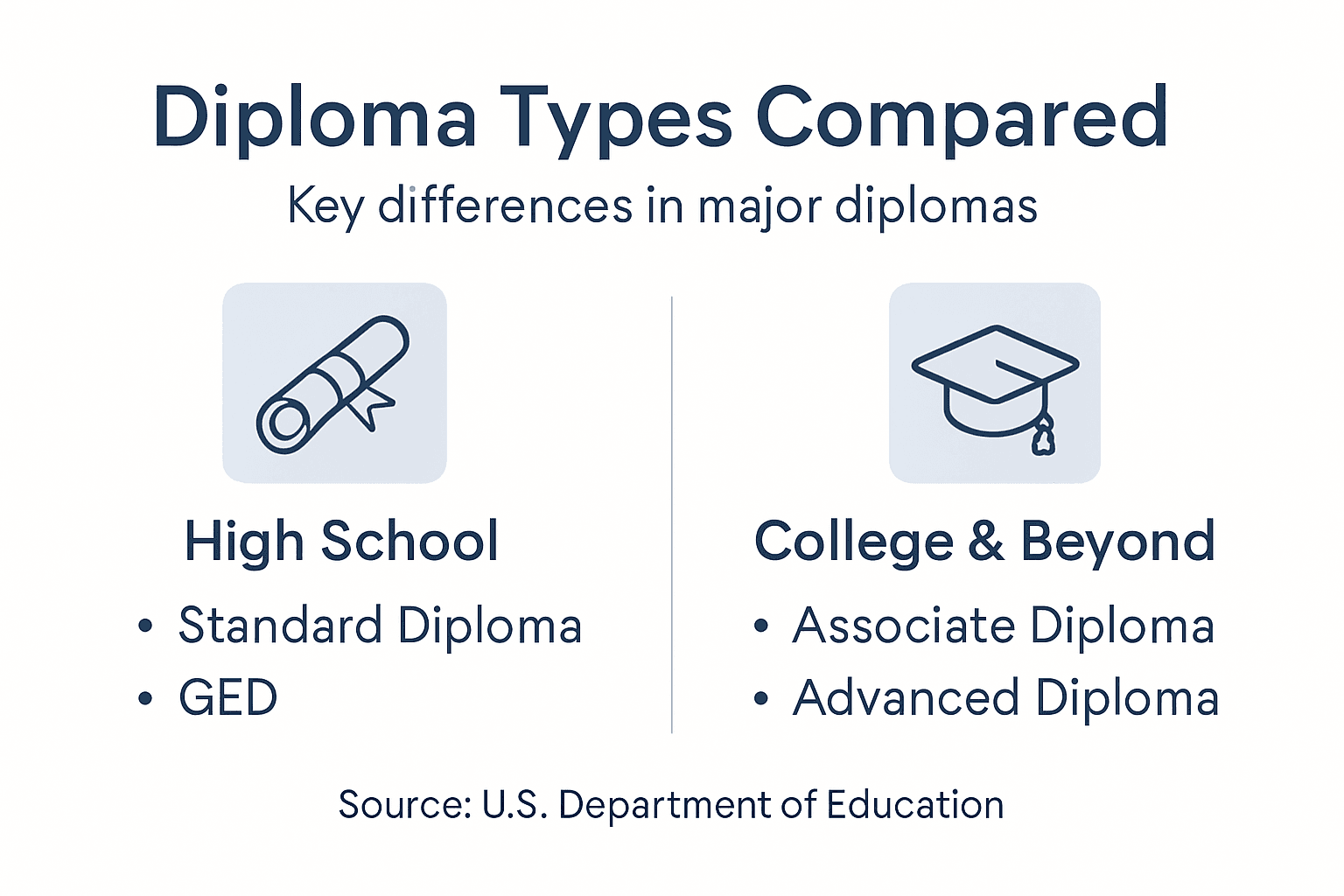
Common High School, GED, and College Diplomas
Three main credential types dominate American education: high school diplomas, GED certificates, and college diplomas. Each serves different purposes and opens different doors.
High School Diplomas
A traditional high school diploma represents completion of a four-year secondary education program. You earn it by attending classes, meeting graduation requirements, and passing state-mandated assessments.
High school diplomas are the baseline credential for most American careers. Employers recognize them as proof of foundational academic knowledge and skill development in core subjects like math, science, English, and history.
Benefits of a traditional diploma include:
-
Direct entry into four-year college or university programs
-
Access to most entry-level professional positions
-
Demonstrated commitment through sustained coursework
-
Full transcript documentation of your academic performance
GED Certificates
The GED (General Educational Development) certificate is an alternative credential for people who didn’t complete traditional high school. GED and high school diploma differences matter when applying to jobs or colleges.

You earn a GED by passing four subject exams covering reasoning through language arts, mathematical reasoning, science, and social studies. Most people complete GED preparation in months rather than years.
GED certificates are widely accepted by employers and colleges, though some institutions treat them slightly differently than traditional diplomas. The credential proves you possess high school-level knowledge and can compete in the job market effectively.
College Diplomas
A college diploma signals completion of higher education at the post-secondary level. These come in various forms—associate degrees (2-year), bachelor’s degrees (4-year), and advanced degrees (master’s, doctorate).
College diplomas represent deeper specialization in specific fields and typically unlock higher-earning career paths. Employers often require bachelor’s degrees for professional positions in business, engineering, healthcare, and technology.
Quick Comparison
| Credential | Duration | Entry Requirements | Career Impact |
| High School Diploma | 4 years | Enrollment in secondary school | Foundation for most careers |
| GED Certificate | 3-12 months | No formal schooling required | Equivalent alternative credential |
| College Diploma | 2-4+ years | High school diploma or GED | Specialized career advancement |
Each credential type serves legitimate purposes—choose based on your timeline, career goals, and educational background.
Pro tip: Before pursuing any credential, research specific employer requirements in your target field; some positions value GED credentials equally to traditional diplomas, while others specifically require college degrees.
Specialized, Vocational, and International Diplomas
Beyond traditional high school and college credentials, specialized diplomas unlock career paths in specific trades and technical fields. International diplomas open doors across borders and to top universities worldwide.
Vocational and Technical Diplomas
A vocational diploma (also called a trade diploma) focuses on practical, job-ready skills in fields like plumbing, electrical work, healthcare, construction, and automotive repair. Technical and vocational education and training programs emphasize hands-on learning aligned with real industry needs.
Vocational diplomas typically take 1-3 years to complete and prepare you for immediate employment. Many trades require vocational credentials before you can work independently or become licensed.
Key advantages of vocational diplomas include:
-
Fast entry into high-demand fields
-
Strong earning potential without four-year degrees
-
Direct training from industry professionals
-
Immediate job market relevance
-
Opportunities for advancement and specialization
International Diplomas
An international diploma is recognized across multiple countries and educational systems. The most prominent example is the International Baccalaureate (IB) Diploma, offered in schools worldwide.
The IB Diploma emphasizes academic breadth across sciences, humanities, languages, and arts, combined with research projects and community service components. Universities globally respect IB credentials, making them valuable for students planning international education paths.
Other international diploma types include:
-
Cambridge International Diplomas
-
Advanced Level (A-Level) qualifications from the United Kingdom
-
European Baccalaureate
-
Country-specific credentials recognized through bilateral agreements
Specialized Professional Diplomas
Many industries offer specialized diplomas after secondary education. Nursing, hospitality management, information technology, and culinary arts all award diplomas recognizing professional expertise.
These credentials sit between vocational training and bachelor’s degrees, providing deeper theoretical knowledge alongside practical application. Employers in specialized fields often prefer candidates with these focused qualifications.
Why These Matter
Specialized and international diplomas serve distinct purposes:
-
Vocational diplomas: Direct pathway to skilled trades and technical careers
-
International diplomas: Global recognition and university admission across borders
-
Professional diplomas: Industry-recognized expertise in specialized fields
Choosing a specialized or international diploma depends on your career goals, timeline, and whether you want credentials recognized in specific industries or internationally.
Pro tip: If you’re considering a vocational or specialized diploma, verify that employers in your target region recognize and value that specific credential before enrolling in the program.
Key Features: Customization, Authenticity, and Recognition
Quality diplomas share three critical characteristics: they offer customization options, maintain authenticity standards, and receive proper recognition. Understanding these features helps you choose the right credential for your needs.
Customization Options
Customizable diplomas allow you to personalize key details to match your specific situation. This matters whether you’re creating a commemorative diploma, theatrical prop, or replacement credential.
Common customization features include:
-
School or institution name
-
Graduation date and year
-
Degree or program title
-
Recipient name and signature lines
-
Special honors or distinctions
-
Seal or logo placement
Diploma customization details like fonts, signatures, and seals matter significantly for realistic appearance and alignment with your intended use.
This table highlights key factors for evaluating a diploma’s value:
| Factor | What to Assess | Why It Matters |
| Customization | Personal details & program info | Ensures personal relevance |
| Authenticity | Accredited source & security marks | Confirms legitimacy |
| Recognition | Employer or university acceptance | Impacts career opportunities |
Authenticity Standards
Diploma authenticity refers to whether a credential meets legitimate standards and appears genuine. Accreditation requirements ensure diploma authenticity and quality by verifying that issuing institutions meet rigorous academic standards.
Authentic diplomas feature:
-
Professional printing quality and paper stock
-
Accurate institutional details and formatting
-
Proper security features (watermarks, holograms, raised seals)
-
Correct grammar and spelling throughout
-
Compliance with institutional standards
Unlike diplomas from diploma mills, legitimate credentials come from institutions with verified accreditation and transparent operations.
Recognition Across Borders
International recognition determines whether employers, universities, or institutions in other countries accept your diploma. This matters for career mobility and further education.
Diplomas gain recognition through:
-
Institutional accreditation by recognized bodies
-
Bilateral agreements between countries
-
Professional licensing boards in specific fields
-
Employer familiarity with the issuing institution
-
International equivalence frameworks
Diploma recognition agreements across regions establish standards for fair evaluation of credentials, helping ensure your diploma holds value internationally.
Why These Features Matter Together
Customization, authenticity, and recognition work together to create valuable credentials.
A customized diploma without authentic production standards looks obviously fake. An authentic diploma without customization options won’t suit your personal or professional needs. A diploma that lacks international recognition might work domestically but limits your global opportunities.
The best diplomas balance all three features: personalized to your situation, produced to authentic standards, and recognized by institutions that matter to you.
Pro tip: When selecting a diploma provider, verify they document their customization process, explain their production standards, and clarify which institutions or jurisdictions recognize their credentials.
Legal Use, Risks, and Responsible Replacement
Understanding the legal landscape around diplomas protects you from serious consequences. Not all diploma uses are legal, and using fraudulent credentials can damage your career and legal standing.
Legal Uses of Replacement Diplomas
Legitimate reasons to obtain a replacement diploma include:
-
Lost or damaged original diploma from an accredited institution
-
Name change requiring updated documentation
-
Theatrical productions and film sets
-
Historical reenactments and educational demonstrations
-
Personal commemorative purposes
-
Displaying achievements in homes or offices
These uses are legal when the diploma accurately represents a real credential you actually earned or when used transparently for entertainment and educational purposes.
Diploma Mills and Fraud Risks
Diploma mills are fraudulent operations that sell fake credentials without requiring legitimate academic work. Diploma mills pose serious legal and career risks by offering unaccredited credentials that misrepresent your qualifications.
Using a fraudulent diploma can result in:
-
Criminal charges for fraud or forgery
-
Job termination and blacklisting from employers
-
Loss of professional licenses or certifications
-
Damage to your reputation and career prospects
-
Legal liability if discovered during background checks
-
Civil lawsuits from employers or institutions
Employers increasingly verify educational credentials, making diploma fraud easy to detect.
Responsible Replacement Standards
Verifying diploma validity and legal compliance ensures you’re following proper procedures for replacements and documentation.
Responsible replacement involves:
-
Obtaining diplomas only from accredited institutions where you studied
-
Using official replacement channels through your school’s registrar
-
Requesting certified copies with verification seals
-
Keeping transparent records of why you needed replacement
-
Never misrepresenting credentials to employers or institutions
Making Safe Choices
The distinction between legal and illegal diploma use comes down to honesty. Using a replacement diploma from your actual school is legal. Using a diploma from a school you never attended to misrepresent your qualifications is fraud.
For theatrical or personal use, transparency matters. Labeling props as “theatrical” or clearly stating “commemorative” protects you legally and ethically.
Legal diploma use means accurately representing your actual education or being completely transparent about non-educational purposes like theater, film, or personal commemoration.
Pro tip: Before obtaining any replacement diploma, contact your school’s registrar office directly—they can guide you through official replacement procedures and provide verified documentation that protects you legally.
Discover the Perfect Diploma for Your Journey with Hey Congrats
Understanding the different types of diplomas can be confusing when you need a high-quality replacement or a realistic prop for personal, educational, or theatrical purposes. Whether you are looking for a high school diploma, GED certificate, or specialized college diploma, finding a credible, customizable option that fits your specific needs is essential for authenticity and peace of mind. At Hey Congrats we solve this challenge by offering custom-made diplomas with precise details like school names and graduation dates that reflect your educational achievements or project requirements.

Explore our complete selection on the Diploma Maker | Custom Replacement & Novelty Diplomas – Hey Congrats! page and find carefully crafted diplomas from various countries including Malaysia College/University Transcripts and Diplomas – Hey Congrats! and Italy College/University Diplomas & Transcripts – Hey Congrats!. Act now to access fast shipping and exceptional customer service at Hey Congrats! where your educational milestones are respected and celebrated with quality and integrity. Start your personalized diploma experience and confidently showcase your achievements or create realistic props today.
Frequently Asked Questions
What is the difference between a diploma and a degree?
A diploma is typically awarded for completing a shorter, skills-focused program, while a degree is awarded for completing a broader, theory-based program at a university level.
Can I pursue a university degree after obtaining a diploma?
Yes, many universities recognize diplomas and offer pathways for diploma holders to enroll in advanced programs or degree-completion paths.
Are vocational diplomas valuable in the job market?
Yes, vocational diplomas are highly valued in trades and technical fields, often providing direct pathways to well-paying jobs without the need for a four-year degree.
What should I consider when choosing a type of diploma?
When choosing a diploma, consider your career goals, the duration of the program, the specialization offered, and how employers in your field view the specific credential.


